
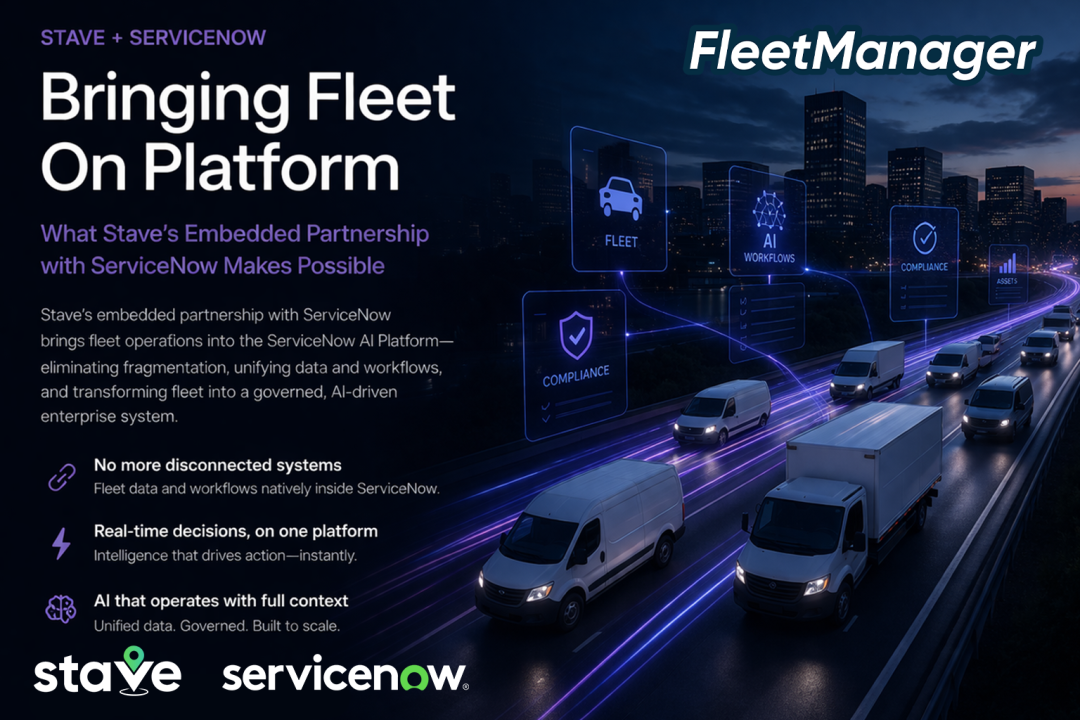
The recent announcement of Stave becoming a ServiceNow Embedded Resell Partner marks an important milestone.
But the real story isn’t the partnership itself.
It’s what this moment makes possible for organizations that have been struggling to manage fleet inside systems that were never designed to support it.
This is where the conversation shifts—from announcement to impact.
The Core Problem: Fleet Has Been Operating Without a System of Action
Across industries, fleet operations have historically been managed through a patchwork of systems:
- Telematics platforms generating high volumes of data
- Maintenance systems tracking service history
- Compliance processes managed through disconnected workflows
- Procurement and financial visibility living in entirely separate environments
Each system serves a purpose.
But none of them operate together.
From a business model perspective, this creates a fundamental breakdown:
- Value is generated in multiple places, but never unified
- Decisions are delayed by fragmented data
- Operational risk increases due to lack of governance
- AI initiatives fail due to incomplete or misaligned inputs
This isn’t a tooling issue.
It’s an operating model issue.
What Changes When Fleet Moves On Platform
With Stave Fleet Manager embedded natively within the ServiceNow AI Platform, fleet is no longer an external function.
It becomes part of the enterprise system.
This shift redefines how value is created and delivered:
1. Unified Value Creation
Fleet data, workflows, and decisions now exist within the same environment as enterprise asset management, service operations, and financial controls.
This creates a single, governed system where:
- Vehicle lifecycle is tied directly to enterprise planning
- Maintenance is orchestrated alongside service workflows
- Procurement and asset utilization are connected in real time
2. Real-Time Decision Infrastructure
Instead of relying on synchronized data across systems, decisions are made directly within the platform.
- No latency between systems
- No reconciliation of conflicting data sources
- No dependency on external integrations to trigger action
3. AI That Actually Operates
AI is only as effective as the environment it operates in.
When fleet is embedded:
- AI has access to complete, governed datasets
- Predictions are contextual, not isolated
- Automation is executed within live workflows
This is the difference between AI as insight and AI as execution.
“Being appointed as an Embedded Partner validates the strategic role fleet plays within enterprise technology,” said Todd Jackson, CEO. “By embedding Fleet directly within the ServiceNow Enterprise Asset Management structure, organizations can now connect vehicle operations to enterprise workflows, governance and AI-driven automation, all within a single platform.”
Todd Jackson, CEO | Stave, Inc.
Why Embedded Changes the Business Case
Most organizations are familiar with API-driven integrations.
They connect systems.
They move data.
They create visibility.
But they do not create control.
From a strategic standpoint, API-based models introduce structural limitations:
- Latency between systems creates delayed decisions
- Fragmented governance weakens compliance and auditability
- Operational complexity increases as integrations scale
- AI effectiveness is constrained by incomplete context
Embedded architecture eliminates these constraints.
By operating natively within ServiceNow:
- Data does not need to be moved—it already exists within the system
- Workflows are executed in a unified environment
- Governance is consistent across all operations
- Intelligence is centralized
The result: a true system of action.
A Business Model Shift: From Tools to Platform-Driven Operations
If we map this to a business model framework, the shift is clear.
Before (Fragmented Model)
- Key Resources: Disconnected systems and datasets
- Key Activities: Manual coordination across tools
- Value Proposition: Visibility into parts of the operation
- Cost Structure: High operational friction and inefficiency
- Risk Profile: Elevated due to lack of unified governance
After (On-Platform Model)
- Key Resources: Unified, governed data within ServiceNow
- Key Activities: Orchestrated workflows across fleet and enterprise systems
- Value Proposition: Real-time, AI-driven operational control
- Cost Structure: Reduced friction, improved asset utilization
- Risk Profile: Lower through centralized compliance and audit visibility
This is not an incremental improvement.
It is a structural shift in how fleet operates as part of the enterprise.
SWOT Perspective: Why This Matters Now
Looking at this through a strategic lens:
Strengths
- Native alignment with the ServiceNow AI Platform
- Unified governance across fleet and enterprise assets
- Real-time operational intelligence and automation
Weaknesses (Legacy Model)
- Fragmented systems and data silos
- Limited ability to operationalize AI
- High dependency on manual processes and integrations
Opportunities
- Predictive maintenance at scale
- Integration of fleet into enterprise financial and operational planning
- Expansion into industry-specific workflows and use cases
- AI-driven optimization across the entire vehicle lifecycle
Threats (If Unaddressed)
- Increasing operational complexity as fleets scale
- Compliance risk due to disconnected systems
- Competitive disadvantage against organizations operating on unified platforms
- AI initiatives failing to deliver measurable outcomes
The takeaway is simple:
The risk is no longer in changing.
The risk is in staying fragmented.
The Role of FTSM™ in This Shift
This is the foundation behind FTSM™ (Fleet Technology Service Management).
A model designed to bring fleet into the same operational discipline as IT and enterprise assets.
Where fleet is:
- Governed within enterprise frameworks
- Managed through structured, automated workflows
- Connected to financial and operational systems
- Powered by AI within the platform
FTSM™ is not a feature set.
It is an operating model.
What Enterprises Can Expect Moving Forward
This milestone is not the endpoint.
It’s the beginning of what becomes possible when fleet is fully on platform.
Organizations can expect:
- Deeper AI-driven automation across fleet operations
- Stronger alignment between fleet, field service, and enterprise asset management
- Faster time to value for existing ServiceNow customers
- Expanded capabilities tailored to industry-specific needs
Most importantly, they can expect a shift in how fleet contributes to the business:
From a cost center…
To a controlled, intelligent, and strategic asset system.
A New Standard for Fleet
Fleet has long been treated as an exception within enterprise technology.
That era is ending.
By bringing fleet onto the ServiceNow AI Platform through an embedded model, we are establishing a new standard:
One where fleet operates with the same level of intelligence, governance, and automation as the rest of the enterprise.
Learn More
For organizations already operating on ServiceNow, the question is no longer if fleet should be brought onto the platform.
It’s how quickly you can make that transition.
Visit stavecorp.com to learn more about Stave Fleet Manager and the FTSM™ approach.
About Stave, Inc.
Stave, Inc., headquartered in Campbell, California, develops ServiceNow-native Operational Technology solutions that connect people, assets, and data across the enterprise. Stave’s applications enable organizations to modernize fleet, asset, and service operations through intelligent, AI-ready data models that enhance visibility, compliance, and performance.
If your company has already done the hard work to secure a ServiceNow investment, don’t leave fleet behind. It’s the missing piece to protecting your ROI and unlocking the full promise of AI-driven business. Explore Fleet Manager on ServiceNow today!